|
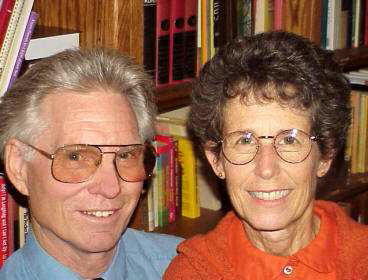
Testimony of Nils and Sherry Jansma
“The kingdom of God is like a man who casts seed upon
the soil; and goes to bed at night and gets up by day,
During the nearly 27 years since we have left the Watchtower organization, we have often reminded ourselves of this scripture. What caused the seed of truth to grow within us? Why were we able to deal realistically with falsehood, when so many of our friends and family members were not? Apparently, there are no easy answers. However, our hope and prayer is that we are only the first fruits of Jehovah's Witnesses and that God will allow us to be instrumental in helping to reveal the truth of the gospel to many of those whose minds are still veiled, whether in this life or the one to come (Matt. 12:32). We have empathy for Witnesses who are struggling to overcome doubts and the fear of potentially losing everything they hold dear. Little did we think when Nils’ father married us in the Kingdom Hall over 50 years ago that we would be writing a testimony like this. We were both third generation Witnesses and pioneers with visions of going into circuit and district work, if Armageddon didn’t come first. Fortunately, Nils had worked briefly for the State of California long enough to become a quasi-trained surveyor, and he was able to work part time in heavy construction using the skills he had acquired. Secretly, he longed to go to college and take courses in civil engineering, but of course, that would show a lack of faith and ruin any opportunity for advancement within the organization. Instead, he took mail-order correspondence courses from ICS. In 1965 when we heard the announcement at the district assembly that the Society planned to build a new factory in Brooklyn, we decided to apply to Bethel on the chance that they might want Nils’ skills as a surveyor enough to invite a married couple to serve there. Because he had worked as a field engineer on a high rise building here in San Diego, Nils knew they would need a surveyor to work on the proposed new construction. To our surprise and delight, we received an invitation to come immediately, so we arrived in Brooklyn in May, 1966. Adjusting to life at Bethel was not particularly easy for either of us—for very different reasons. I am 5 feet tall and weigh 85 pounds, so for the first 21 years of my life, I had never been expected to do much hard physical work. At Bethel, I was assigned to work as a housekeeper all by myself. The daily grind of keeping 13 dormitory rooms spotlessly clean, between bouts of crying, was not exactly the paradise I had envisioned Bethel life to be. Nils soon observed that those with a college education (obtained before they became Witnesses, of course) were treated with honor and great respect; whereas, those who had denied themselves an education by faithfully pioneering were treated as expendable tools for those in charge to use as seen fit. As time went on, however, our circumstances improved. Instead of crying, I learned to work hard and then discovered that my small size and youthful-sounding speaking voice allowed me to become involved in recording dramas and performing a regular role on the Society’s weekly radio program. As Nils was expected to do more and more engineering work on the new factory building, the Society allowed him to enroll in night school at the Brooklyn Polytechnical University to get the education he needed. One thing we learned very quickly at Bethel was to “never demonstrate your deficiency,” as one wise family member put it. Consequently, we never admitted that we couldn’t do a particular job. Rather, we volunteered with self-assured enthusiasm for any interesting assignment and then acquired the needed skills along the way. Obviously, getting an education was not unscriptural—getting an education without the approval of the organization was the problem. After the district assembly in the summer of 1966, Bethel was buzzing with the “new light” that Armageddon would come by 1975. Neither Nils nor I were convinced of the chronology offered by Fred Franz because Jesus had said no one would know the day or the hour. In retrospect, maybe we always had a “bad attitude” because we found it difficult to deny plain and simple Bible truths in favor of the sometimes creative organizational “party line.” So we were a voice of caution, especially when Nils’s parents prematurely cashed in their retirement account “in faith.” This was a difficult period. In the worst case scenario, we figured if the Society discovered they were wrong in calculating the date 1975, they would acknowledge their error, and we would likely get some new “new light” that offered a more plausible explanation. As a result, we were willing to wait and see what would happen. By 1971 after almost 5 years of Bethel service, Nils and I decided to leave and move back to California. It was difficult to say goodbye to so many good friends, but the monotony of the daily schedule at Bethel and the pressure to get a better education finally outweighed any joy we had in our extracurricular activities. There was no room for advancement (especially for women), and any ambition was viewed as a lack of humility and, therefore, a reason for demotion. We figured if 1975 didn’t work out as many expected, we might be able to return, having acquired the skills needed to become involved in more challenging work assignments. When we arrived back in California, I began pioneering again, and Nils enrolled in college, majoring in engineering. One thing our years at Bethel had taught us was to no longer allow a group of men with selfserving and often unpredictable standards to dictate the course of our lives. As one Bethelite put it, “The Bethel experience causes one to lose one’s fear of man.” We still believed that Jehovah was directing the organization, but maybe not as precisely as we had originally thought. The Society, as bad as it seemed sometimes, was the only organization we thought had the “sayings of truth,” so where else could we go (John 6:68)? Since the elder arrangement had just come into being and Nils qualified, he became a card-carrying college student and an elder at the same time. The local brothers were suspicious and confused by this combination, but were unable to argue against it since the Society had allowed Nils to go to school during his stay at Bethel. Also Nils had told them of our plans to return to Bethel some day where his education could be put to good use. As 1975 approached, we began to hear the preliminary murmurs of denial from the Society rather than any honest admissions or apologies for their dreadful mistake. Finally, I remember sitting at the Watchtower study one Sunday listening to the brothers and sisters parroting the information from the study article and innocently taking all of the blame for misinterpreting what the Society had said about 1975. It was the first of several occasions when I longed to jump up from my seat, run to the podium, and argue for the apparently forgotten truth. Instead, I sat there and thought how much the Society was like the Scribes and Pharisees in Jesus’ day—burdening the people with heavy loads that they were not willing to budge with their finger (Matthew 23:4). If any rank and file Witness had been called up before a committee, accused of an indisputable sin, and in response blatantly denied it, and then tried to blame other innocent people instead, that person would have been disfellowshiped for sure. Yet that was exactly what the Governing Body members were doing! How could I continue to respect them as spiritual leaders? Nils had come to the same conclusion a few years earlier. After becoming increasingly disillusioned and depressed by the lack of love and common sense reasoning demonstrated at committee and elders’ meetings, he had resigned as an elder. He still attended meetings and used his engineering expertise to help the brothers in construction projects, but his attitude both toward the Society and toward so-called “worldly people” had changed dramatically. He figured that if Jehovah was using this organization, then he might be using others as well, because we were not any better (and sometimes worse) than other religions. Nevertheless, he couldn’t imagine ever completely leaving and becoming a part of them because he still believed in the basic moral and non-political views of the Witnesses. I managed to sweep my doubts under the carpet and continued to pioneer. One day when going from door to door, I got into a discussion with a lady about the heavenly and the earthly hopes. I read her John 10:16 and told her that the “other sheep” were those who would live on the earth. “No, they’re not,” she said. “The other sheep are the Gentiles.” Immediately, my mind raced to think of scriptures that would refute her assertion. To my dismay, I could only think of how much sense it would make if the other sheep were the Gentiles. That interpretation would fit so nicely with the rest of the Greek Scriptures where the Apostle Paul spoke about Jesus’ death destroying the wall between the Jews and the Gentiles and making the two parties one—one flock, one Shepherd. I told the lady I would return with proof of my two-class position. I went home and was confident that when I looked up the original Watchtower article, I would find some ready answers explaining John 10:16. What an eye-opener that article was! The reasoning to prove that the other sheep were an earthly class was so twisted and complicated—going from the Abrahamic Covenant to the New Covenant and then back again—that I knew I could never return to that lady and convince her to accept my convoluted argument when hers appeared to be the clear and simple truth. I was both fascinated and devastated at the same time. If the other sheep were the Gentiles, then the whole basis for the Society’s two-class system was wrong! There was only one hope, and it was heaven—for all Christians. Needless to say, that prospect was very unappealing to me. I had been conditioned by the Society to view Christendom’s heaven as a boring place where angels floated around on clouds forever. I wanted to live on a paradise earth. So as a good Witness, I dutifully swept this doubt under the carpet to join the others that were accumulating there, but my enthusiasm and conviction for converting others had suffered a serious blow. It was at this time that I no longer could study the Society’s publications with people. Instead, we studied the Bible alone, using the Society’s chain references to clarify difficult scriptures. I have come a long way since then. I didn’t realize how limiting the Society’s view of our life in the future was. They look forward to an existence bound by the frailty of our fleshly bodies and restricted to this small planet earth. In contrast, God has placed before us the prospect of unlimited freedom made possible by being given new glorified bodies that can and will live in both the new heavens and the new earth (Romans 8:20-23). The Apostle John says, “Beloved, now we are children of God, and it has not appeared as yet what we shall be. We know that, when He appears, we shall be like Him, because we shall see Him just as He is.” After Jesus was resurrected, he appeared to his followers to give them an idea of what our glorified bodies would be like. Jesus ate and drank physical food, but he also had the kind of body that could appear and disappear at will and apparently operate beyond the laws of our physical universe. What could be a more exciting hope than that? Sometimes people ask us what to say to Witnesses at the door when they ask; “Wouldn’t you want to live forever on a paradise earth?” We encourage a positive response saying, “Yes, but I also look forward to having access to the dwelling places or abodes described by Jesus at John 14:2. God intends for Christians to be able to live both in heaven and on the earth. Doesn’t that sound appealing to you?” This response is certainly an attention getter. In all my days of going from door to door, I never heard any Christians say they looked forward to living on the “new earth,” as well as in heaven. Amid this period of change and confusion, both Nils and I were beginning to wonder what Jehovah had in store for us, if anything. Then an unexpected event happened that gave us a whole new outlook on life. After 15 years of marriage, I was told by my doctor that we were going to have a baby. That changed everything. When our daughter Ariane was born in January, 1978, Nils stopped attending meetings. He didn’t want to raise Ariane as a Witness and require her to take a stand on issues that he was no longer convinced were valid, such as birthdays and blood transfusions. However, he didn’t oppose me because he was sure that I would not be able to ignore the truth’s compelling influence indefinitely. Therefore, in the interim, I could do as I saw fit with his blessing. So rather than go to our Kingdom Hall alone with a baby, I began attending the Hall where my mother and other family members went. However, I used the baby as an excuse to skip most of the meetings. The book study, the public talk, and the service meeting had become so abysmally boring to me, hearing the same information over and over again, that I felt they were a waste of time. Interestingly, a few quick years later Ariane began to think that meetings were even worse than a waste of time and occasionally let her feelings be known. For me, that experience has come to be viewed as validation of Jesus’ “out of the mouth of babes” statement (Matt. 21:6; Ps. 8:2). It should go without saying that during this period, our friends and family were naturally quite worried about us. We had been so active and involved in everything, and now we were considered “weak.” Most of them blamed Nils for putting doubts in my mind because he had always been outspoken and critical of the Society’s questionable organizational edicts and doctrinal experiments. As a result, I was determined not to let his arguments influence me, so I often found myself defending the Witnesses, even though I suspected in my heart that they were wrong. In the midst of our spiritual chaos, we heard that Ray and Cynthia Franz had been dismissed from Bethel. What a shock! We had known them personally and liked them when we were there. In fact, Ray had always been a voice of reason, it seemed. Therefore, the rumors we began hearing about their disgusting apostasy and their Judas-like attitude didn’t describe the kind, loving, mature couple we had known, so we were very curious to discover what had really happened. Consequently, when Ray’s book Crisis of Conscience was published, Nils immediately bought a copy and brought it home. We devoured it, hearing the ring of truth on every page, especially since we personally knew many of the people Ray wrote about. After reading Ray’s book, I continued to attend the few meetings I could endure, but Nils began reading the Bible and the writings of the early ante-Nicene (before 325 BCE) Christians. He also began watching a local weekly TV program entitled Know Your Bible. When the host of Know Your Bible used the account of the Father, the Son, and the Holy Spirit all being individually present at Jesus’ baptism to support the trinity doctrine, rather than to disprove it as we had always done, a light went on in Nils’s mind. He researched the history and content of the Nicene Creed and soon realized that the Society did not understand the real definition of the trinity. They were defining it as if it were modalism (Sabellianism), which is the idea that God has appeared in three different modes or identities, always separated by time and space. In other words, modalism says that God could never appear simultaneously as both the Father and the Son; whereas, the doctrine of the trinity teaches that he can and did. We had always been taught by the Society that if God and Jesus were “one,” then they could never appear to be present at the same time as at Jesus’ baptism. However, that is a mistaken view. Those who believe in the trinity use the presence of the three together as proof that the doctrine is correct. Interestingly, Modalism was quickly declared to be a heresy by the early church and is still considered unorthodox today. That is what is so ironic about the Society's position. They are making a big fuss and constantly seeking to disprove an “unorthodox” doctrine that has already been rejected by the majority of Christians. Nils was truly amazed! The Watchtower Society, supposedly God’s only spokesperson on earth, has spent an excessive amount of time and energy refuting an incorrect view of the trinity. Nils figured they did this because modalism itself, is easily disproved scripturally. There are many instances that place Jesus and God together at the same time and place. However, the actual doctrine of the trinity, as defined by the Nicene Creed, appears very difficult, if not impossible, to disprove scripturally. It now became clear to him that the only apparent difference between what the Witnesses believe about Jesus and what Christendom teaches about the trinity boils down to what Jesus was originally made or composed of. Was Jesus supernaturally produced out of nothing, as the Society teaches, making him a separate creation like the angels? Or is he the “only begotten son,” existing in the same unique form or composed of the same unique substance as God, making him eternal Deity (John 1:1; Phil. 2:6)? Other than that physical distinction, Jesus’ actual working relationship to the Father is about the same for both the Society and Trinitarians. For Nils, this was a very comforting realization. It had always bothered him to think that the Society’s God “loved” us so much that he said, in effect, “Hey, you, Jesus my Son, go in my place and die for all mankind, or else.” However, because we now understand that God, through Jesus, personally agreed from “before the foundation of the world” (1 Peter 1:20) to suffer for us, we likewise understand that God’s love is just as personal. He did not ask nor expect someone else to suffer for us in his behalf. What magnificence! Only God could figure out how to both die and live for us at the same time. So as it turned out, accepting Jesus as Deity was as clear to Nils as the other sheep being the Gentiles was to me. At this point, if we had been in a normal religion instead of a cult, we would probably have left immediately. But, circumstantially, we had a lot to lose. All of our friends and family were Witnesses, and we couldn’t ignore our responsibility to raise our daughter to love God and to associate with moral people. Additionally, I had “disproved” Christendom’s teachings so many times, I couldn’t imagine suddenly accepting them and attending a church full of hypocrites (as the Society often described churchgoers). However, over the next couple of years, two significant events took place that caused us to hesitantly take that first big step into a church building. We read Thus Saith . . . The Governing Body by Randy Watters. When we saw actual written proof of how many times in the past the Society had prophesied falsely, just as they had done regarding 1975, we had no choice but to do what Deuteronomy 18:20-22 told us to do—not to listen to the false prophet who came in Jehovah’s name. There was no way we could ignore this plain and simple command. At the same time, Nils had been corresponding with the host of Know Your Bible, John Banks, who believed in a “young earth” and that the creative days of Genesis chapter 1 were each 24-hours long. Nils (who now had a Masters degree in engineering and geology) was of the opinion that the earth was old and that the days of creation were long periods of time. John Banks, who was able and willing to accommodate personal opinions, recommended that Nils attend a series of lectures being given at a local church by a man, John Clayton, who believed much the same as Nils did about the age of the earth. So it was on a very rainy Friday night in February of 1986 that we walked into a church, away across town where we would not be recognized by anyone we knew. To be on the safe side, we even gave false names and regarded everyone present with suspicion, speaking only when spoken to. However, John and Nils were immediately kindred spirits when it came to science and the Bible. Amusingly, when John sensed Nils’s reluctance to be identified, he innocently said, “You must belong to a cult or something.” After the session, we were invited to return on Sunday and attend a Bible study. The group was studying the book of Acts and going through each chapter verse by verse, without an organizational Bible study aid to guide them. This was an exciting change for us. Here people were asking questions and referring to a variety of different Bible commentaries. Some people respectfully disagreed with the opinions expressed by the person conducting the study, and it was okay! In preparation for the next week, Nils bought a slew of commentaries, and a whole new world of Bible study opened up to us. Ariane was 8 years old at the time and immediately fell in love with Sunday School after the first five minutes (surprise, surprise). It was a welcome relief from the hours of boredom at the Kingdom Hall. Soon my mother (who had read Crisis of Conscience) joined us, along with some inactive Witness friends. Every Sunday, we sat in the front row during the sermon with tears often streaming down our faces. Hearing a positive message about the love of Christ was a cathartic experience for us. But in accord with our Watchtower programming, we kept waiting for all of the “hypocritical Christians” to show their true colors and gossip or backbite or fornicate on the pews, but it never happened. Finally, we gave our real names and revealed our Witness association. Apparently, most people had already guessed we were Witnesses because we kept saying “Jehovah,” but they were content to let us progress at our own pace and in our own way. In fact, though we attended that church for many years, they never required us to become members. We had already been enrolled, through baptism, as members in Christ’s body, the true, universal church, so any earthly memberships were for bookkeeping purposes only and not officially necessary. In the meantime, rumors were flying around the Kingdom Hall about us. One Sunday, without our knowledge, several elders, who had been our close friends, followed us across town and spied on us as we entered the church. They then called us up before the committee. We brought Ariane along so that she could see for herself what was happening to us and why. In the course of the conversation, Nils asked the brothers if they had read Crisis of Conscience. One overseer said he hadn’t, but he knew it was full of lies. Afterward, Ariane said she had wanted to interrupt to ask him how he could know there were lies in a book if he hadn’t read it. His attitude helped in convincing her that the Witnesses didn’t have the truth. Incidentally, even though we had left the Witnesses, Ariane still insisted that she would not salute the flag at school nor participate in some of the holidays. We never opposed her in this, but as time went by, she came to see for herself that saluting the flag was an act of respect and not worship, as we had once taught her. As far as holidays are concerned, Paul said they were not salvation issues but a matter of personal conscience that one had to work out “in his own mind.” (Romans 14:5). During the committee meeting, the elders kept trying to get us to admit that we were no longer Witnesses so they could say we had disassociated ourselves. Nils decided not to make it easy for them to get rid of us. He believed that if they had to struggle with enforcing the Society’s unscriptural rules, they might also lose faith in the organization. So Nils’ position was this—We are still witnesses for Jehovah, and we fully agree with the Organization when it is in harmony with the Bible. In accord with the Society’s witnessing policy, our Christian conscience requires that we be truthful when going from door to door. Therefore, if anyone asks us about the history of Jehovah’s Witnesses, we will have to tell them, in truth, that they have prophesied falsely. We can prove that from the literature. To require us to say anything different would be the same as forcing us to engage in deceptive recruiting practices, and we are certain that the Society would not want to endorse that practice as a part of their witnessing policy. To make sure, Nils sent a barrage of letters to the Society (always with copies to the local elders) asking them to answer the charge of deceptive recruiting, but of course, they never responded. Finally after a year of ignoring us completely, the brothers suddenly insisted on another committee meeting. If we didn’t show up, it would be taken the same as a letter of disassociation. If we did show up, we weren’t allowed to take notes or to have anyone accompany us during our interrogation. When we got there, they required us to meet with them separately. All they asked us was the “new” (at that time) question the Society had added to the baptism confession—Did we consider that our baptism in the holy spirit meant that we were baptized into the spirit directed organization? I said I had not been asked that question at my baptism, so it didn’t apply to me. I agreed with the Organization as long as it acted in harmony with the Bible. I clearly said that I was not disassociating myself from Jehovah’s Witnesses. They thanked me and said I could leave. Nils went through the same procedure and gave similar answers. Later, we heard that a vague announcement had been made at the congregation saying, in effect, that we were no longer considered Jehovah’s Witnesses. Nils immediately wrote to the Society saying that the local congregation had made an announcement that was apparently not in harmony with the Society’s policy regarding “deceptive recruiting.” He requested confirmation of the Society’s approval of the local congregation’s actions in declaring us as “non members” because we would not agree to engage in deceptive recruiting practices. He stressed that he was sure that the Society didn’t support such immoral and coercive conduct and that if they did not affirm the action of the local congregation, we would assume a mistake had been made. Since we have heard nothing from the Society to the contrary, we assume a mistake was made and that we are still Jehovah’s witnesses in good standing. It is our position that if the Society would allow us to tell the truth about false prophecy at the door in their name, we may still actively associate with them. For this reason, we can honestly say that we have not been disfellowshiped nor have we disassociated ourselves from Jehovah’s Witnesses. In fact, when Nils has had occasion to confront the local Witness elders regarding this issue, they have reassured him that we have not been disfellowshiped and shouldn’t be treated as such. Of course, over time, everyone, including our close family members, treated us as if we had been. While this was painful to us, we nevertheless wanted our family to know that such actions were their decision and that the Society did not “officially” support their behavior. Toward the end of both of Nils’ parent’s lives, they softened in their treatment of us. This may have been due to their personal needs or because we were not officially labeled as ungodly people. It was maintaining this distinction that strongly influenced our efforts to not allow the Society to easily disfellowship or disassociate us. During the past 20 years, we have grown both educationally and spiritually. Nils has earned a doctorate in Biblical archaeology, and I have a Masters degree in Reading and Language Arts. Spiritually, we have grown into the Christians we always envied—those who really love Jesus and feel his presence in every area of their lives. Our cynicism is essentially gone, and in its place we are learning to trust. We rejoice every day for the freedom we have in Christ to read the Bible and apply all of the scriptures to ourselves without having it filtered by organizational creeds and laws. Although we’ve been able to help some of our friends and family members to leave the Witnesses, the bulk of our ministry has involved educating fellow Christians about science and the Bible. Nils has updated a book written over 40 years ago by John Clayton, entitled The Source. The book harmonizes Genesis chapter 1 with the fossil record and clarifies many misunderstandings that Christians may have about scientific issues. He has subsequently also written a Work Book for The Source with questions to use in discussions and updated information. You can see his work at: www.thebeginning.us . I have written Journey Through a Jewel, a novel based on our many trips through the Grand Canyon, whitewater rafting along the Colorado River while helping to coordinate and conduct a series of Bible classes about God’s creation. Throughout the story, the reader is swept along the river, through magnificent scenery and turbulent rapids. Grand Canyon history and arguments for belief in God are intertwined as the two main characters embark on a journey of self-discovery and faith. If you are interested in more information about either book, please click here: http://www.sljansma.com/index.html During the years ahead, we hope to continue in a ministry involving science and the Bible. This subject is not important to people of faith, but it is to those searching for faith. We especially find young people being torn between loyalty to traditional beliefs and what they are learning in school. Churches today need to have a panel of “experts” in science and the Bible who can answer the difficult questions about the subject, so our ministry strives to help equip these would-be experts to educate others. As far as our position with the Society and Jehovah’s Witnesses is concerned, we always want to be available to any who are in need of help. While we do not seek confrontation, we do not run from it either. There are many powerful arguments that can have a compelling effect on the Society, if properly used. We have found that deceptive recruiting, as alluded to in our testimony, is the most useful. Other similar arguments can be used to reconcile disagreements between husband and wife, if conflicts arise. While this is not our primary focus at this time, we are always willing to offer whatever assistance we can.
|